
The study titled “Psychedelics reopen the social reward learning critical period” was conducted by researchers at Johns Hopkins University after they discovered a novel critical period for social reward learning. Critical periods are mechanistically constrained windows of time during specific periods of brain development where the nervous system exhibits heightened sensitivity to ethologically-relevant stimuli, along with increased malleability for behavioral modifications. These critical periods end after a certain age, but researchers found that they can be reopened using psychedelics.
To test this, researchers used mice to study the effects of psychedelic drugs on social reward learning. They found that all types of psychedelic drugs tested (empathogenic, hallucinogenic, oneirogenic, and dissociative) all are able to reopen the critical period for social reward learning in adult mice. For reference, empathogenic psychedelics include MDMA, hallucinogenic LSD and psilocybin, oneirogenic ibogaine, and dissociative ketamine. These findings mean that adult mice that have been treated with any of these psychedelic drugs are able to learn about social rewards as effectively as young mice.
How long do these critical period reopenings last?
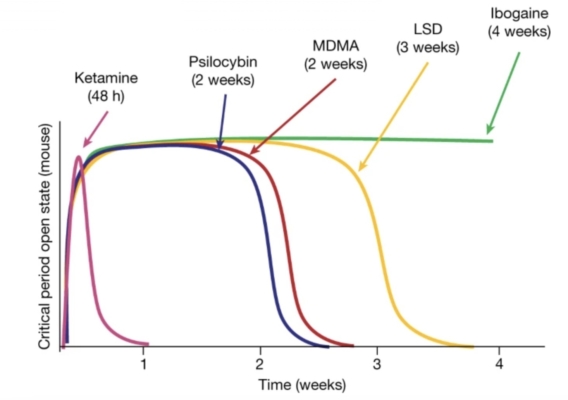
The duration of critical period reopening correlated with the duration of each drug’s subjective effects. Source: Nature
When comparing the duration of critical period reopenings across psychedelics, data showed that ketamine-treated mice did not exhibit significant social reward learning, while those treated with psilocybin did. At the two week mark, the social reward learning critical period remained opened for both psilocybin- and LSD- treated mice. At the three week mark, only LSD-treated mice exhibited social reward learning. Lastly, at four weeks, only ibogaine-treated mice continued to show significant social reward learning. In a prior paper published by the same authors, researchers showed that MDMA-induced critical period reopening lasts for two weeks but returns to the closed state by four weeks.
What this data presents is that the duration of the critical period reopening corresponds to how long the subjective effects of the drugs are experienced in humans. Researchers explain that the duration of the acute subjective effects and the length of the therapeutic effects can vary widely across psychedelics. For example, a ketamine trip lasts 30-120 minutes, but its antidepressant effects can last for a week. Other drugs have longer acute effects such as LSD and ibogaine lasting around 8-10 hours and 36-72 hours, respectively. The paper posited that the longer the effects are felt, the longer the critical period remains open. Thus, ketamine had the shortest effect on these critical periods, while ibogaine had the longest. These results coincide with the duration of each drug’s acute subjective effects.
What is the neurological process behind reopening critical periods?
The researchers also found that the reinstatement of social reward learning is linked to a process called metaplastic restoration of oxytocin-mediated long-term depression in a specific brain region called the nucleus accumbens. Oxytocin is a hormone that is involved in social bonding and reward. The nucleus accumbens is a brain region that is involved in processing rewards. The researchers found that psychedelic drugs can increase the expression of oxytocin receptors in the nucleus accumbens, which leads to the restoration of oxytocin-mediated long-term depression. This, in turn, leads to the reopening of the critical period for social reward learning. These results showed that psychedelics induce metaplasticity rather than hyperplasticity. Distinguishing the difference between the two is important, as knowing that they induce metaplasticity can help design biomarkers to test therapeutic profiles.
The role of the 5-HT2A receptor in critical period reopening

The 5-HT2A receptor is a key player in the mechanism of action of psychedelics. Source: Biologic Models
After effect duration and neurological process were established, researchers aimed to discover the molecular mechanisms responsible for reopening critical periods. They started with the quintessential psychedelic receptor, the 5-HT2A receptor. This is a serotonin receptor that has long been found to be involved in the mechanism of action of psychedelics.
The researchers wanted to understand the role of the 5-HT2A receptor in reopening a critical period for social reward learning using these drugs. They conducted experiments on adult mice, administering the psychedelics either alone or together with a substance called ketanserin, which blocks the 5-HT2A receptor.
The results showed that LSD and psilocybin, when given to the mice, caused the reinstatement of social reward learning, but this effect was blocked when ketanserin was given along with the psychedelics. On the other hand, MDMA and ketamine were able to reinstate social reward learning even in the presence of ketanserin.
These findings suggest that while 5-HT2A is necessary for the reopening of the critical period by LSD and psilocybin, MDMA and ketamine can achieve this without relying on the 5-HT2AR receptor. This challenges the idea that psychedelics should be classified solely based on their interaction with the 5-HT2A receptor, commonly referred to as serotonergic psychedelics.
The role of the β-arrestin-2 receptor

The β-arrestin-2 receptor is activated by the active form of GPCRs, which includes the 5-HT2a receptor. Source: ScienceDirect
To further analyze which receptor was responsible for reopening critical periods, researchers investigated the role of the β-arrestin-2 receptor. To investigate the role of β-arrestin-2 signaling in the ability of psychedelics to reopen a critical period for social reward learning, researchers observed the social reward learning behavior in both normal mice and mice without β-arr2 receptors after administering psychedelic drugs.
The results showed that in normal mice, LSD and MDMA could reopen the critical period for social reward learning, but this effect was absent in mice without β-arr2 receptors. However, ketamine and ibogaine were able to reinstate social reward learning in both types of mice. This further provides insights into specific mechanisms required for critical period reopening.
Conclusion
These studies offer new insights into how psychedelics work and their potential therapeutic benefits. Psychedelics have shown promise in treating conditions like depression, PTSD, and addiction. The findings of this study propose that psychedelics may reopen critical periods in brain development, which could explain their ability to enhance psychological flexibility and cognitive reappraisal. This mechanism could have implications for a wide range of behaviors and conditions beyond social reward learning. The shared molecular mechanisms involved in critical periods and the effects of psychedelics provide a potential avenue for further research and expanding the applications of psychedelics in various disorders. Finally, the research suggests that psychedelic drugs could be used to treat neuropsychiatric disorders that are characterized by impaired social reward learning, such as autism spectrum disorder and social anxiety disorder.